



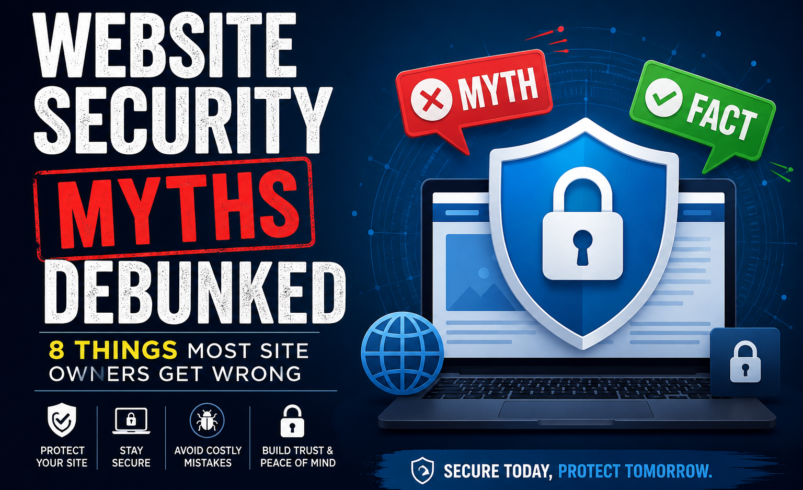

Website security is one of those topics where dangerous half-truths thrive. Most site owners have picked up a few assumptions along the way — from hosting sales pages, tech forums, or well-meaning colleagues — that sound reasonable but are fundamentally wrong.
These myths don’t just create a false sense of security. They lead to real decisions that leave real websites exposed to real attacks, every single day.
Let’s debunk the eight most common website security myths — and replace them with what you actually need to know.
Myth 1: ‘I’m Too Small to Be Targeted by Hackers’
This is the single most dangerous myth in website security — and it persists because it feels intuitively true. Why would a sophisticated hacker waste time on a small business blog or a local eCommerce store?
The answer: most hackers aren’t targeting you specifically. They’re running automated bots that scan millions of websites simultaneously, looking for any site with a known vulnerability. Your size is completely irrelevant to a bot. What matters is whether your site has an unpatched plugin, a weak password, or a misconfigured server.
Small websites are often more attractive targets precisely because they’re less likely to have proper security in place. You’re not too small to be attacked. You may be too small to recover if you don’t take it seriously.
Myth 2: ‘My Website Has SSL, So It’s Secure’
The padlock icon in your browser bar means one thing: the connection between your visitor and your server is encrypted. Data sent between them can’t be intercepted in transit.
It means absolutely nothing about what’s on your server. A website infected with malware, running a card skimmer on checkout pages, or serving phishing content to visitors can — and frequently does — have a perfectly valid SSL certificate.
SSL is a baseline requirement in 2025. It is not a security strategy.
Myth 3: ‘My Hosting Provider Takes Care of Security’
Hosting providers secure their infrastructure — the physical servers, the network, the operating system. They do not secure your website application.
The plugins you install, the CMS version you run, the passwords you choose, the code your developer wrote — all of that is your responsibility. And it’s at the application layer where the overwhelming majority of website hacks occur.
Read the terms of service for your hosting plan. Most explicitly state that website-level security is the account holder’s responsibility. If your site gets hacked, your host will typically suspend your account — not clean it up for you.
Myth 4: ‘I Would Know Immediately If My Site Was Hacked’
This myth is particularly dangerous because it breeds complacency. In reality, most website infections are specifically designed to be invisible to the site owner.
Hackers don’t want you to know. Malware that redirects visitors to spam sites often only fires for users who aren’t logged into the admin panel. SEO spam pages are hidden from administrators. Card skimmers operate silently in the background. Backdoor shells sit dormant until needed.
Many site owners discover they’ve been hacked only when a customer complains, Google shows a blacklist warning, or their hosting account is suspended — days or weeks after the initial compromise. Proactive monitoring exists precisely because you can’t rely on noticing it yourself.
Myth 5: ‘Strong Passwords Are Enough Protection’
Strong passwords are important — but they only protect against one attack vector: credential-based attacks like brute force and credential stuffing.
They do nothing against SQL injection attacks that bypass your login entirely. They don’t stop a hacker who exploits a vulnerability in an outdated plugin. They won’t prevent malware being injected through a compromised third-party script. They’re one layer of protection — and a single layer is never enough.
Myth 6: ‘I Don’t Have Anything Worth Stealing’
Hackers aren’t only interested in stealing your data. A compromised website is valuable for many reasons:
- Server resources for sending spam, mining cryptocurrency, or launching attacks on other sites
- Your domain’s established reputation for SEO spam campaigns
- Visitor traffic to redirect to malicious or affiliate sites
- Your email infrastructure for phishing campaigns
- A stepping stone to attack your customers or business partners
Even a simple brochure website with no customer data has value to an attacker. The assumption that you have nothing worth stealing is simply incorrect.
Myth 7: ‘A Security Plugin Is All I Need’
WordPress security plugins like Wordfence or iThemes Security are useful tools — but they have significant limitations that many site owners don’t understand.
Server-side security plugins run on your own web server, which means they consume your hosting resources and can only act after a request has already reached your server. A cloud-based WAF blocks attacks at the edge, before they reach your server at all. Most security plugins also don’t include guaranteed malware removal, comprehensive blacklist monitoring, or DDoS mitigation.
Security plugins are a useful component of a broader security strategy. They are not a complete solution on their own.
Myth 8: ‘Free Security Tools Give Me Adequate Protection’
Free security tools — free WAF tiers, free scanner plugins, free CDN plans — are better than nothing. But free tiers are specifically designed to demonstrate value while withholding the features that matter most in a real attack scenario.
Free WAF tiers typically use delayed rule updates (meaning new threats aren’t blocked immediately), lack virtual patching for CMS vulnerabilities, provide minimal support, and exclude incident response. When something goes wrong — and statistically, it will — a free tier leaves you on your own.
For personal hobby sites, free tools may be adequate. For any website that generates revenue, handles customer data, or matters to your business — they’re not enough.
The Reality: What Proper Website Security Looks Like
The Myth | The Reality |
I’m too small to be targeted | Bots attack all sites indiscriminately — size is irrelevant |
SSL means my site is secure | SSL only encrypts transit data — it doesn’t stop malware or hacks |
My host handles security | Hosts protect infrastructure, not your website application layer |
I’d know if I was hacked | Most hacks are silent — owners discover them days or weeks later |
Strong passwords are enough | Passwords don’t stop plugin exploits, SQL injection, or XSS attacks |
I don’t have anything worth stealing | Hackers want server resources, traffic, and your domain reputation too |
Security plugins are sufficient | Plugins help but can’t replace a WAF + active monitoring + expert response |
Free security tools cover me | Free tiers lack virtual patching, active monitoring, and incident response |
Proper website security combines prevention (a WAF blocking attacks at the edge), detection (continuous malware scanning and monitoring), and response (professional malware removal when something gets through). Sucuri delivers all three in a single platform — replacing myths with genuine, measurable protection.
🔍 Which of these myths have you been relying on? Get real protection for your website with Sucuri today — and replace dangerous assumptions with a security layer that actually works.
The most expensive security mistake you can make is assuming you don’t need it — until the moment you realize you did.