

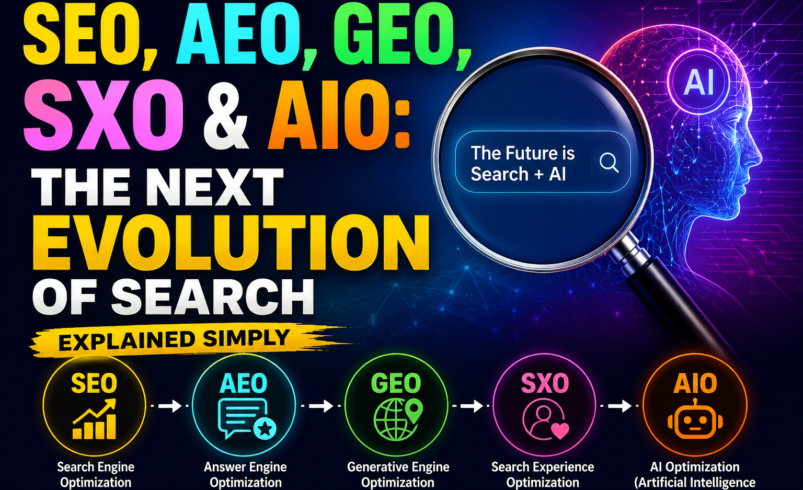

SEO, AEO, GEO, SXO & AIO:
The Next Evolution
of Search
The search landscape has been permanently transformed by AI. Here's your complete playbook for every dimension of modern search — from Google rankings to AI Overviews, voice answers to generative engines.
The Search Revolution Has Arrived
In 2026, "doing SEO" no longer means one thing. Search has fragmented into a multi-channel, AI-mediated ecosystem where your content must perform across Google's blue links, AI Overviews, ChatGPT, Perplexity, Gemini, voice assistants, and dozens of other generative surfaces — simultaneously.
"The era of optimizing for one search box is over. Today, your content must earn citations in AI answers, rank in traditional SERPs, satisfy user intent, and survive machine summarization — all at once."
These five disciplines aren't competing strategies — they're layers of a unified approach. Let's unpack each one, and then show you how they work together.
The foundation. Technical health, E-E-A-T signals, on-page content, and backlinks for traditional search rankings.
Structuring content to be surfaced in voice assistants, featured snippets, and direct-answer formats.
Getting cited in AI-generated responses from ChatGPT, Perplexity, Gemini, and other LLM-based search engines.
Merging SEO with UX — optimizing the full journey from search query to on-page conversion and satisfaction.
Specifically targeting Google's AI Overview feature, which now appears on the majority of informational queries.
SEO Era 1.0
Keyword stuffing, meta tags, directory links. Rankings were the only metric that mattered.
Content & Authority Era
Google Panda, Penguin, Hummingbird. Quality content and natural links became the core currency.
Intent & Experience Era
BERT, Core Web Vitals, E-A-T. Search began understanding meaning, not just matching words.
AI Disruption Begins
ChatGPT's explosion, Google SGE launch, Perplexity's rise. The zero-click era accelerates dramatically.
Multi-Engine Reality
GEO and AIO become essential disciplines. Search is no longer a single destination but a distributed ecosystem.
SEO in 2026:
The Evolved Foundation
Traditional SEO hasn't died — it has evolved. In 2026, Search Engine Optimization remains the bedrock that all other disciplines depend on. But the game has fundamentally shifted from "rank for keywords" to "become the definitive source" in your domain.
What's Changed in SEO for 2026
Google's Helpful Content System and E-E-A-T (Experience, Expertise, Authoritativeness, Trustworthiness) framework now dominate ranking decisions far more than keyword density or even backlinks alone. The algorithm increasingly rewards depth of expertise, real author credentials, original research, and user satisfaction signals.
🔑 Core Ranking Factors in 2026
E-E-A-T signals (especially demonstrated real-world Experience), topical authority depth, Core Web Vitals performance (INP is the key metric now), mobile-first indexing, structured data, content freshness, and brand search volume all carry heavier weight than ever before.
2026 SEO Checklist
- Establish clear author expertise with bylines, credentials, and author schema
- Build topical authority — cover entire subject clusters, not isolated keywords
- Optimize Interaction to Next Paint (INP) — Google's newest Core Web Vital
- Implement comprehensive Schema markup (Article, FAQ, HowTo, Product, Review)
- Earn editorial backlinks from authoritative, topically relevant domains
- Update and refresh existing content on a regular schedule
- Build brand signals: press mentions, Wikipedia presence, knowledge panel
- Conduct regular technical audits for crawlability, indexation, and internal linking
⚠️ What's Hurting Rankings in 2026
Mass-produced AI content without human expertise layering, thin affiliate pages, excessive interstitials, Core Web Vitals failures, and relying on high-volume generic keywords without real topical depth are the leading causes of rank decline this year.
AEO: Answer Engine Optimization
Answer Engine Optimization (AEO) is the discipline of formatting and structuring your content so that search engines, voice assistants, and AI systems can extract and surface direct answers. It bridges traditional SEO with the conversational, question-based nature of modern search.
With over 1 billion voice searches conducted monthly and featured snippets appearing on 12%+ of queries, AEO is no longer optional for content marketers.
How AEO Differs from Traditional SEO
Where SEO focuses on making your page rank, AEO focuses on making your answer visible — often without users ever clicking to your site. This sounds counterintuitive, but brands that dominate answer surfaces build massive brand recognition and trust that drives subsequent direct searches.
💡 Answer Formats to Target
Paragraph answers (concise 40–60 word definitions), numbered lists (step-by-step processes), table answers (comparison data), and "People Also Ask" clusters are the most common featured snippet formats. Each requires different content structuring.
AEO Implementation Strategy
- Lead every section with a direct, clear answer to the implied question
- Use exact question phrases as H2/H3 headings ("What is X?", "How does Y work?")
- Implement FAQ Schema on every page with question-answer content
- Keep definition paragraphs between 40–60 words for snippet optimization
- Use numbered lists for processes (Google prefers them for "how to" queries)
- Create structured comparison tables for "X vs Y" queries
- Register your brand with Bing/Cortana, Apple, and Amazon knowledge bases
- Optimize for long-tail conversational queries (5+ words)
GEO: Generative Engine Optimization
Generative Engine Optimization (GEO) is the newest and arguably most disruptive discipline in the group. It focuses specifically on getting your brand, content, and expertise cited by AI language models — ChatGPT, Perplexity AI, Google Gemini, Claude, and other generative AI search engines.
Unlike traditional SEO where you can see a specific algorithm's inputs, GEO requires understanding how LLMs learn, retrieve, and synthesize information from across the web at training and inference time.
🤖 Why GEO is Different
AI models don't rank pages — they synthesize information and cite sources. To appear in AI answers, you need to be a trusted, well-linked, authoritative source that AI retrieval systems (like RAG pipelines) will pull from when generating responses. Being "famous on the web" genuinely matters here.
The GEO Citation Framework
Source Authority
AI systems trained on Common Crawl weight highly-linked, high-traffic domains
Build editorial backlinks from authoritative publications
Quote-ability
LLMs learn quotable statistics, definitions, and expert opinions
Create original research, publish proprietary data and studies
Brand Mentions
Unlinked brand mentions across the web signal credibility
PR campaigns, podcast appearances, industry roundups
Structured Content
Well-structured content is easier for RAG systems to chunk and retrieve
Clear headings, concise paragraphs, defined sections
GEO Action Items for 2026
- Publish original research, surveys, and proprietary data that gets cited across the web
- Write clear, quotable "expert statements" that AI can extract as authoritative summaries
- Get featured in high-authority publications (Forbes, industry blogs, academic references)
- Maintain a detailed, accurate Wikipedia presence or Wikidata entry
- Create content specifically addressing questions AI users commonly ask
- Use consistent brand voice and terminology so models learn your brand's "language"
- Test your GEO by querying AI engines: "Tell me about [your brand/topic]"
SXO: Search Experience Optimization
Search Experience Optimization (SXO) is the merger of SEO and UX — recognizing that Google's ranking algorithm increasingly uses user behavior signals as a proxy for content quality. If users click your result and immediately bounce, you're penalized. If they click, engage, convert, and return — you're rewarded.
SXO demands that marketers stop thinking about "getting the click" and start thinking about "satisfying the entire journey" — from the moment a user types a query to the moment they achieve their goal.
The SXO Journey Model
1. Discovery
Find a relevant result in the SERP
Title tags, meta descriptions, rich snippets that match intent
2. Arrival
Confirm they're in the right place within 3 seconds
Hero message alignment, page speed, mobile rendering
3. Engagement
Consume content that solves their problem
Content structure, readability, multimedia, internal linking
4. Conversion
Take the desired action (buy, sign up, contact)
CTA placement, trust signals, form UX, page flow
5. Return
Come back directly or recommend to others
Email capture, content quality that earns bookmarks/shares
Key SXO Metrics
- Dwell time and scroll depth as quality signals (2+ minutes is a strong indicator)
- Pogo-sticking rate — users returning to SERP immediately signals poor relevance
- Core Web Vitals: LCP under 2.5s, INP under 200ms, CLS under 0.1
- Mobile usability score in Google Search Console
- Click-through rate optimization via A/B tested title tags and meta descriptions
- Heatmap and session recording analysis to identify UX friction points
AIO: AI Overview Optimization
AI Overview Optimization (AIO) is the discipline of specifically targeting Google's AI Overviews feature — the AI-generated summaries that appear at the very top of search results for a large and growing percentage of queries.
Launched as SGE (Search Generative Experience) in 2023 and rolled out globally through 2024–2025, Google AI Overviews now dominate informational and commercial research queries. Being cited in an AI Overview drives significant brand exposure and residual traffic.
📊 AIO by the Numbers in 2026
AI Overviews appear on approximately 47% of all Google searches in the US. Pages cited in AI Overviews see an average CTR increase of 9% for clicks from the citation chips — but total organic traffic from those queries often decreases as users find answers without clicking.
How Google Selects AI Overview Sources
Google's AI Overview draws primarily from pages that already rank in the top 10 for the query, with a strong preference for pages that provide clear, comprehensive, trustworthy, and well-structured information. Key signals include:
- Already ranking on page 1 for the target query is the strongest signal
- Having comprehensive, multi-faceted coverage of the topic on a single page
- Strong E-E-A-T signals — especially real author credentials and organizational trust
- Structured data that helps Google understand content hierarchy and meaning
- Concise, extractable passages that answer the query directly
- Recent publication or update dates — Google prefers fresh information
- Being cited or linked from other authoritative sources on the same topic
AIO Content Architecture
To maximize AI Overview inclusion, structure your pages with what practitioners call "passage-level optimization" — writing distinct, self-contained paragraphs that can answer specific aspects of a query even when extracted from surrounding context. Every H2 section should begin with a clear, direct answer to the implied sub-question.
🏗️ The AIO-Ready Page Structure
Introduction with a direct answer summary → H2 sections with question-format headings → concise opening sentences for each section → supporting detail → FAQ section with Schema → author credentials → clear "last updated" date. This architecture serves both readers and AI extraction systems simultaneously.
Side-by-Side Comparison
How do the five disciplines differ across the key dimensions that matter to marketers?
| Discipline | Primary Target | Key Metric | Time to Results | Difficulty in 2026 |
|---|---|---|---|---|
| SEO | Google / Bing SERPs | Organic rankings & traffic | 3–12 months | High (competitive) |
| AEO | Featured snippets, voice, PAA | Snippet capture rate | 2–6 months | Medium |
| GEO | ChatGPT, Perplexity, Gemini | AI citation frequency | 6–18 months | Very High (new) |
| SXO | Full search-to-conversion journey | Dwell time, conversion rate | 1–4 months | Medium |
| AIO | Google AI Overviews | AI Overview inclusion rate | 1–6 months | Medium-High |
The Unified 2026 Search Strategy
The most important insight of 2026 is that these five disciplines reinforce each other. A page built with GEO best practices (authoritative, well-cited, clearly structured) almost automatically performs better for SEO, AEO, SXO, and AIO. The disciplines share a common root: genuine expertise, communicated clearly, to serve real human intent.
The Content Hierarchy That Serves All Five
- Expertise Layer: Original research, proprietary data, genuine expert opinions — irreplaceable by AI
- Structural Layer: Logical H1→H6 hierarchy, structured data, clear passage boundaries
- Answer Layer: Direct question-answer pairs at section openers for AEO and AIO
- Experience Layer: Page speed, mobile UX, visual clarity for SXO
- Authority Layer: Author credentials, brand mentions, backlinks for SEO and GEO
Priority Matrix by Goal
Drive traffic volume
SEO (topical authority, technical health)
AEO for PAA capture, SXO for retention
Build brand awareness
GEO (citations in AI answers)
AIO, AEO for maximum SERP presence
Improve conversions
SXO (full journey optimization)
SEO for qualified traffic, AIO for trust
Win informational queries
AIO + AEO (direct answer content)
SEO for ranking to qualify for overviews
Tools & Resources for 2026
The right toolkit matters. Here are the essential platforms for executing across all five disciplines:
Start Your Multi-Pillar Search Strategy Today
Don't wait for traffic to decline. The brands winning in 2026 started optimizing for AI-driven search in 2024. Here's where to start.
Frequently Asked Questions
What is the difference between SEO and GEO?
SEO (Search Engine Optimization) focuses on ranking your pages in traditional search engine results pages like Google and Bing, where links are presented to users who then choose to click. GEO (Generative Engine Optimization) focuses on getting your brand and content cited within AI-generated responses from tools like ChatGPT, Perplexity, and Google Gemini — where the AI synthesizes an answer from multiple sources rather than showing a list of links. Both are now essential, but require different strategies: SEO relies heavily on links and technical signals, while GEO depends more on brand authority, original research, and "cite-ability."
Is SEO dead in 2026?
No — SEO is far from dead in 2026, but it has evolved significantly. Traditional SEO practices like technical optimization, backlink building, and content quality remain foundational. What has changed is that SEO is now one of five interconnected disciplines rather than the only search strategy a brand needs. Additionally, the goal of SEO has expanded: it's not just about driving clicks but also about building the authority foundation that makes you eligible for AI Overviews, generative engine citations, and featured snippets.
How do I get included in Google AI Overviews?
To get included in Google AI Overviews, your content must first rank on page one for the target query — that's the baseline requirement. From there, focus on: (1) comprehensive, trustworthy content with clear E-E-A-T signals, (2) a well-structured page with question-format headings and direct-answer passage openings, (3) proper Schema markup, (4) a recent publication or update date, and (5) strong brand authority signals. Pages that already appear in featured snippets or People Also Ask boxes are most likely to be cited in AI Overviews for the same queries.
What is AEO and why does it matter in 2026?
AEO (Answer Engine Optimization) is the practice of structuring content to be surfaced as direct answers in voice search results, featured snippets, and "People Also Ask" boxes. It matters in 2026 because zero-click searches — where users get their answer directly in the SERP without clicking — now account for more than half of all Google searches. Brands that dominate answer formats gain massive visibility and authority, even if they don't always get the click. AEO also serves as the foundation for AIO (AI Overview Optimization), since both require similar content structuring.
How long does it take to see results from GEO?
GEO is the slowest of the five disciplines to show measurable results, typically requiring 6–18 months of consistent effort. This is because AI models are trained on historical web data and don't update in real time. However, AI search engines that use RAG (Retrieval-Augmented Generation) — like Perplexity and Bing Copilot — can surface your content much faster, sometimes within weeks of publication if your content is authoritative and indexed. The most impactful GEO activities are publishing original research, earning editorial mentions in major publications, and maintaining a strong Wikipedia/Wikidata presence.
Should I optimize for all five disciplines simultaneously?
Yes — and fortunately, the disciplines share significant overlap. A well-crafted content strategy that prioritizes genuine expertise, clear structure, comprehensive topic coverage, and strong user experience will naturally perform across all five areas. For resource-constrained teams, start with SEO as the foundation (since ranking on page 1 is a prerequisite for AIO), then layer in AEO through structured content and Schema markup, then improve SXO through UX audits. GEO is a longer-term investment that requires PR and authority building. AIO-specific tactics can be implemented alongside AEO with minimal additional effort.