Quadruped Robot: The Future of Agile and Intelligent Robotics
Sanjay Krishna
Jun 10, 2026
The rapid advancement of robotics technology has led to the development of highly sophisticated machines capable of navigating complex environments. Among these innovations, the quadruped robot has emerged as one of the most versatile and efficient robotic platforms. Inspired by four-legged animals, these robots are designed to move with stability, adaptability, and precision across challenging terrains where traditional wheeled robots often struggle.
What Is a Quadruped Robot?
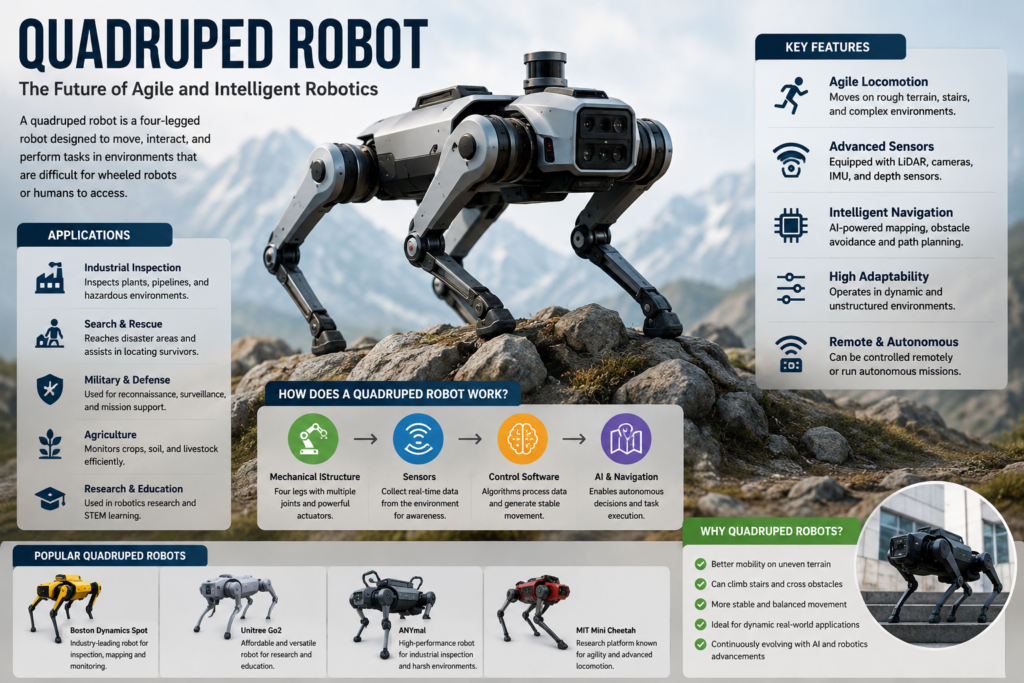
A quadruped robot is a robotic system that uses four legs for locomotion. By mimicking the movement patterns of animals such as dogs, wolves, and horses, these robots can maintain balance while walking, running, climbing stairs, and traversing uneven surfaces. Advanced sensors, actuators, and artificial intelligence enable them to react to their surroundings in real time, making them ideal for dynamic environments.
Key Features of Quadruped Robots
Modern quadruped robots are equipped with cutting-edge technologies that enhance their performance and reliability. Some notable features include:
- Advanced balance and motion control systems
- Real-time obstacle detection and avoidance
- AI-powered navigation capabilities
- High mobility on rough terrain and stairs
- Remote operation and autonomous functionality
These capabilities make the quadruped robot a valuable solution for industries requiring flexible and efficient robotic assistance.
Applications of Quadruped Robots
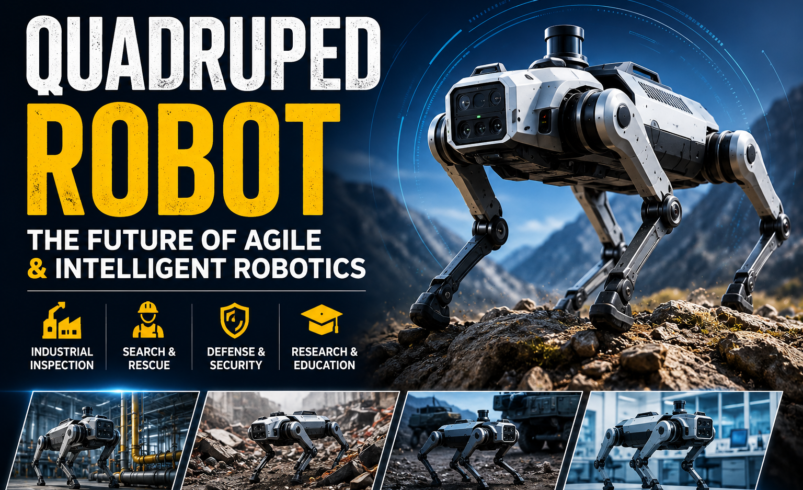
The use of the quadruped robot continues to expand across various sectors. In industrial environments, these robots perform inspections in hazardous locations, reducing risks for human workers. Search and rescue teams utilize them to access disaster zones and locate survivors. In agriculture, quadruped robots assist with monitoring crops and livestock, while research institutions employ them to study advanced locomotion and artificial intelligence systems.
Additionally, military and security organizations are exploring the potential of quadruped robots for reconnaissance and surveillance missions in difficult terrains.
The Future of Quadruped Robot Technology
As artificial intelligence and robotics continue to evolve, the future of the quadruped robot looks increasingly promising. Improvements in battery life, machine learning, and sensor technology will enable these robots to operate more efficiently and autonomously. Future generations are expected to collaborate with humans in industries such as logistics, healthcare, construction, and public safety.
With their unique combination of mobility, adaptability, and intelligence, the quadruped robot is set to play a significant role in shaping the future of automation. Businesses and researchers worldwide are investing heavily in this technology, ensuring that the quadruped robot remains at the forefront of robotic innovation for years to come.
The quadruped robot represents a major breakthrough in modern robotics, offering unparalleled mobility and operational flexibility. From industrial inspections to disaster response and scientific research, these four-legged machines are transforming how tasks are performed in complex environments. As technology advances, quadruped robots will become even more capable, creating new opportunities across multiple industries.
About Author
Sanjay Krishna