

If your website has a padlock icon in the browser bar, you might feel like your security bases are covered. You have HTTPS. You have an SSL certificate. Surely that’s enough, right?
Unfortunately, this is one of the most widespread and costly misconceptions in website security — and it puts thousands of website owners at risk every day.
An SSL certificate and full website security are two very different things. Understanding the difference could be the most important thing you do for your website this year.
What Is an SSL Certificate — And What Does It Actually Do?
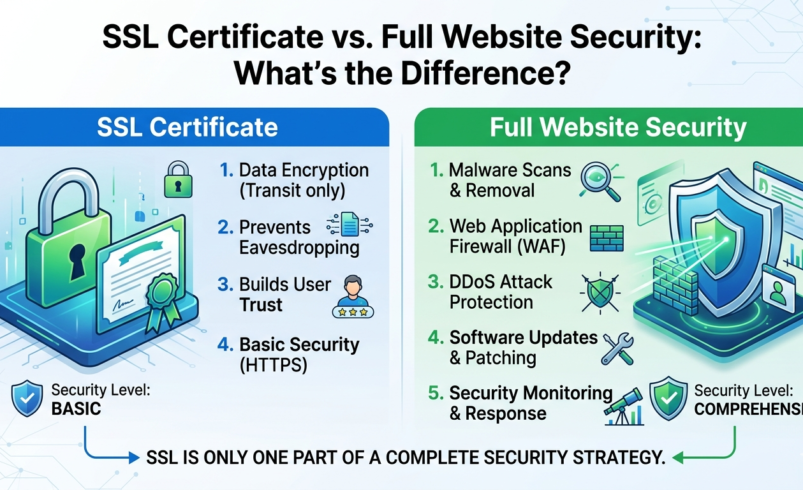
SSL stands for Secure Sockets Layer (now technically TLS — Transport Layer Security, though most people still say SSL). An SSL certificate does one specific thing: it encrypts the data transmitted between your visitor’s browser and your web server.
That’s it. It makes the connection private. When someone fills in your contact form or enters their payment details, SSL ensures that data can’t be intercepted in transit by a third party.
This is genuinely important. Without SSL, data sent between users and your site travels in plain text — readable by anyone who intercepts it. SSL fixes that. And Google has made HTTPS a ranking factor, which means sites without it are penalized in search.
But here’s the critical point: SSL has nothing to do with what happens on your server, inside your website files, or in your database. It’s a transport layer protection — not an application layer protection.
What SSL Does NOT Protect Against
This is where the misconception gets dangerous. An SSL certificate offers zero protection against:
- Malware injected into your website files by hackers
- SQL injection attacks targeting your database
- Cross-site scripting (XSS) attacks served to your visitors
- Brute force attacks on your admin login
- DDoS attacks that overwhelm your server
- Backdoors that give hackers persistent access to your site
- SEO spam pages silently added to your site
- Your domain being blacklisted by Google or security databases
In other words: a hacked website with an SSL certificate still shows the padlock. Visitors see the green lock and assume they’re safe — while malware is being served to their browsers, or their data is being silently harvested from your compromised database.
SSL tells visitors the connection is encrypted. It says nothing about whether the content being delivered over that encrypted connection is safe.
A Practical Analogy
Think of SSL like a sealed, tamper-evident envelope. It ensures the letter inside can’t be read or changed in transit. But it says absolutely nothing about whether the letter itself contains something harmful.
Full website security is what checks the contents of the letter — scanning for malware, blocking malicious senders before they get through, and making sure nothing harmful reaches your visitors in the first place.
What Full Website Security Actually Covers
A comprehensive website security solution operates at the application layer — the layer where the actual content of your site lives. Here’s what that protection looks like in practice:
- Web Application Firewall (WAF): Inspects incoming traffic and blocks malicious requests — SQL injections, XSS attacks, brute force attempts — before they reach your site.
- Malware scanning: Continuously checks your files and database for injected code, backdoors, and suspicious changes.
- Blacklist monitoring: Alerts you if your domain is flagged by Google, McAfee, Norton, or other security databases.
- DDoS mitigation: Absorbs and filters volumetric and application-layer attacks before your server is overwhelmed.
- Malware removal: When something gets through, professional cleanup with guaranteed results.
- File integrity monitoring: Detects unauthorized changes to your core files, alerting you to intrusions in real time.
Side-by-Side: SSL vs. Full Website Security
Feature | SSL Certificate Only | Full Website Security (Sucuri) |
Encrypts data in transit | ✅ Yes | ✅ Yes |
Blocks malware & malicious code | ❌ No | ✅ Yes |
Web Application Firewall (WAF) | ❌ No | ✅ Yes |
Malware scanning & monitoring | ❌ No | ✅ Yes |
DDoS protection | ❌ No | ✅ Yes |
Brute force login protection | ❌ No | ✅ Yes |
Blacklist monitoring & alerts | ❌ No | ✅ Yes |
Malware removal (guaranteed) | ❌ No | ✅ Yes |
Performance CDN | ❌ No | ✅ Yes |
Shows padlock in browser | ✅ Yes | ✅ Yes |
Do You Still Need SSL?
Absolutely — SSL is a baseline requirement for any website in 2025. It protects data in transit, builds visitor trust, and is a Google ranking factor. The good news is that SSL certificates are now free via Let’s Encrypt and included with most hosting plans.
But SSL alone is table stakes. It’s the minimum, not the finish line.
Who Is Most at Risk from Relying on SSL Alone?
- eCommerce stores: SSL protects payment data in transit — but if your server is compromised, card details can be skimmed before encryption even occurs.
- WordPress sites: The most-targeted CMS on the internet. SSL doesn’t protect vulnerable plugins or themes.
- Lead generation sites: A hacked contact form can harvest every enquiry and redirect visitors — SSL won’t stop this.
- Any site handling personal data: GDPR and data protection regulations require reasonable security measures — SSL alone does not meet that bar.
The Right Security Stack for 2025
Think of website security in layers:
- SSL/TLS: Encrypts data in transit. Free, essential, non-negotiable.
- Web Application Firewall: Blocks application-layer attacks before they reach your site.
- Malware monitoring: Detects infections early, before they cause serious damage.
- Blacklist monitoring: Ensures you know immediately if your site is flagged.
- Malware removal plan: Know who cleans your site and how fast if something goes wrong.
Sucuri covers layers 2 through 5 in a single platform — a cloud-based WAF, continuous malware scanning, blacklist monitoring across all major databases, and guaranteed malware removal with unlimited re-cleans. Pair it with a free SSL certificate from your hosting provider and your website has the comprehensive protection it actually needs.
🔒 SSL is just the start. Get complete website security with Sucuri — and protect your site at every layer, not just in transit.
The padlock tells your visitors the connection is private. Full website security tells them — and you — that the content itself is safe.