

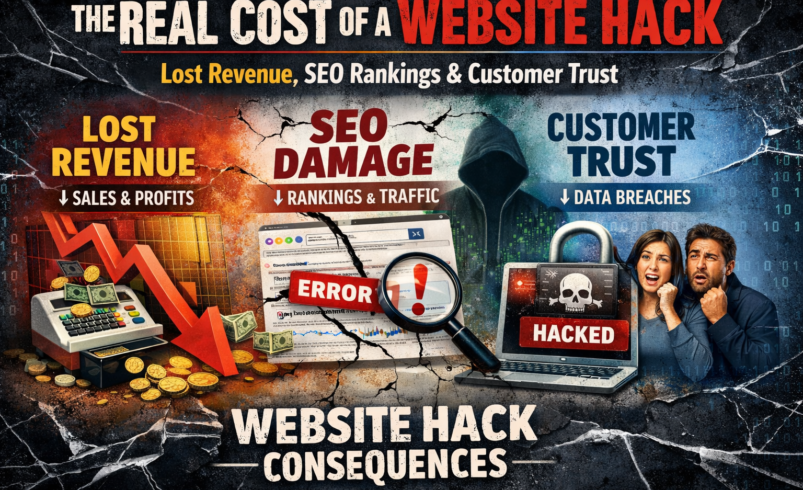

When most website owners think about getting hacked, they picture a dramatic worst-case scenario: customer data stolen, systems wiped, years of work destroyed. And while that certainly happens, the far more common reality is quieter — and in many ways more insidious.
Your site gets hacked. You don’t notice for days or weeks. And during that time, the damage quietly accumulates: in lost revenue, in Google penalties, in customer trust that evaporates without a trace.
This post breaks down the real, measurable cost of a website hack — and why investing in prevention is one of the smartest financial decisions a website owner can make.
The Numbers Are Worse Than You Think
Cybersecurity researchers estimate that a website is attacked every 39 seconds on average. Over 30,000 websites are hacked daily — the vast majority of them small businesses that assumed they were too insignificant to be targets.
The average cost of a cyberattack for a small business? Studies consistently put it in the range of $25,000 to $200,000 when all direct and indirect costs are tallied. For many small businesses, that’s existential. But even a ‘minor’ hack carries a price tag most owners never fully calculate.
1. Direct Revenue Loss from Downtime
When your website is infected with malware, several things can take it offline or make it inaccessible:
- Your hosting provider detects malware and suspends your account
- Google’s Safe Browsing flags your site and blocks visitors with a warning page
- Malware redirects visitors to spam pages, driving them away
- Infection slows your site to the point of being unusable
For an eCommerce store doing $1,000/day, even 48 hours of downtime means $2,000 gone — and that’s before cleanup costs. For service businesses, it means lost leads you’ll never even know about.
2. SEO Rankings: The Damage That Lingers Longest
This is the cost that surprises most business owners — because it’s not immediately visible, and it can outlast the hack itself by months.
When Google detects malware or spam on your site, it penalizes your rankings and can de-index your pages entirely. The content you spent months building can effectively disappear from search results overnight.
Recovering your SEO after a hack typically involves: cleaning all malware and spam content, submitting a Google review request, waiting weeks for re-crawling, and rebuilding authority lost during the blacklisting period. Industry data suggests organic traffic can take 3 to 6 months to fully recover — even after the site is completely clean.
3. Emergency Cleanup Costs
Professional malware removal services typically charge anywhere from $200 to $2,000+ depending on severity and site complexity. And if every backdoor isn’t removed, hackers simply return — meaning many site owners pay for cleanup twice or three times over.
This is why services offering guaranteed cleanup with unlimited re-cleans are worth the investment. One infection cleaned properly costs far less than multiple repeat incidents.
4. Customer Trust — The Cost You Can’t Quantify
When a visitor lands on your site and sees a Google security warning, what do they do? They leave. And they don’t come back.
Research consistently shows that a significant portion of users won’t return to a website that previously showed security warnings — even after the issue is resolved. For service businesses and eCommerce stores, trust is everything. A hacked website can undo years of brand building in days.
Consider the compounding effect: a customer who would have bought from you repeatedly over five years is gone forever. The cost isn’t one lost sale — it’s the lifetime value of that relationship.
5. Legal and Compliance Exposure
If your website collects any personal data — names, emails, payment information — a breach can expose you to significant legal liability under GDPR, CCPA, or PCI-DSS. Fines can run into hundreds of thousands of dollars depending on your jurisdiction and the scale of the incident.
Even if no data was actually stolen, regulators look at whether you had reasonable security measures in place. If you didn’t, sympathy is in short supply.
6. The Hidden Cost: Your Time
The hours spent dealing with a hack are hours not spent running your business. From identifying the problem, to communicating with your hosting provider, to liaising with a security team, a serious incident can easily consume a full week of your time.
At even $50/hour, 40 hours of crisis management is $2,000 in pure opportunity cost — and that doesn’t include the stress and mental burden of a security emergency.
The ROI of Prevention
A comprehensive website security platform like Sucuri costs a fraction of what a single hack incident typically costs. For a modest annual investment, you get:
- Continuous malware scanning and early detection
- A web application firewall blocking attacks before they reach your site
- Blacklist monitoring with instant alerts
- DDoS protection
- Guaranteed malware removal with unlimited re-cleans
- A global CDN that speeds up your site while keeping it secure
When you compare that against the potential cost of just one hack — the downtime, the SEO recovery, the cleanup, the lost customers — the math is overwhelming. Website security isn’t an expense. It’s insurance against a loss that would cost far more.
🔒 Start protecting your website before the costs hit. Explore Sucuri’s security plans here — malware removal, WAF protection, blacklist monitoring, and more. One platform. One price. Total peace of mind.
The question isn’t whether you can afford website security. It’s whether you can afford not to have it.