

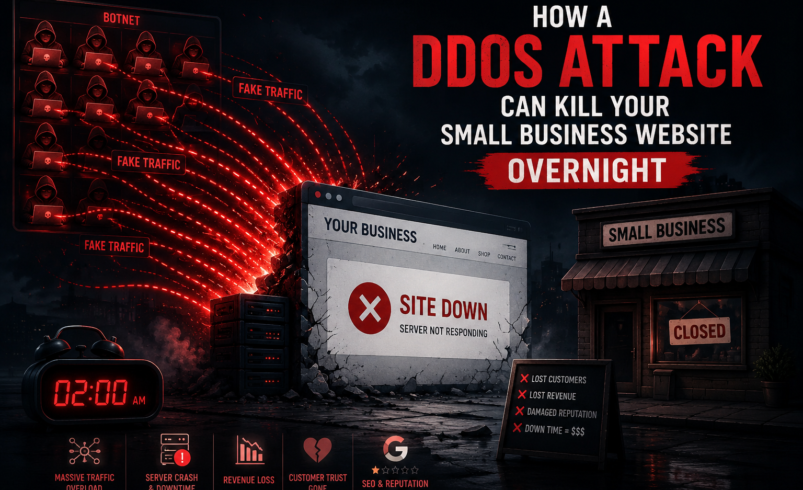

It started as a normal Tuesday morning for a small eCommerce store owner. Orders were coming in, the website was humming along — and then, without warning, everything stopped. The site was down. Customers were getting errors. Support emails flooded in.
It wasn’t a server glitch. It wasn’t a hosting outage. It was a DDoS attack — and by the time it was over, the business had lost an entire day of sales, several loyal customers, and its hard-earned search rankings.
If you run a website — any website — a DDoS attack is a very real threat. And the idea that ‘I’m too small to be targeted’ is one of the most dangerous myths in website security.
What Is a DDoS Attack?
DDoS stands for Distributed Denial of Service. In simple terms, it’s when a massive number of fake requests flood your website all at once, overwhelming your server until it can no longer respond to legitimate visitors.
Think of it like thousands of prank callers all dialing your business phone simultaneously. No real customer can get through. Your server gets completely overwhelmed and eventually gives up.
The ‘distributed’ part means these fake requests come from thousands of different devices around the world — often infected machines called a botnet — making the attack nearly impossible to stop by simply blocking a single IP address.
Why Would Anyone Attack a Small Business Website?
This is the question most small business owners ask — and the answer is more unsettling than you’d expect. Attacks don’t always require a personal motive. Common reasons include:
- Extortion: Attackers take your site down and demand payment to stop.
- Competition: A competitor wants your site offline during a critical period.
- Hacktivism: Ideologically motivated attacks against certain industries.
- Opportunistic bots: Automated scripts that target thousands of websites indiscriminately — yours included.
- Distraction: A DDoS used to distract while hackers attempt a data breach elsewhere.
Most small business attacks fall into the ‘opportunistic’ category — automated bots scanning the internet for easy targets. If your site isn’t protected, it’s an easy target.
The Real Damage a DDoS Attack Causes
- Lost revenue: Every hour of downtime is revenue you’ll never recover — especially critical during launches, sales events, or peak seasons.
- Hosting costs spike: Many hosting providers charge for excess bandwidth during an attack, or suspend your account entirely.
- SEO damage: Google crawls your site regularly. Downtime during crawls can drop your rankings — and recovery takes weeks or months.
- Customer trust: Customers who can’t reach your site go to a competitor. Many won’t come back.
- Team productivity: Your staff stops everything to deal with the crisis instead of growing the business.
Can Your Hosting Provider Handle a DDoS Attack?
Most shared hosting providers offer some level of network-layer protection — meaning they can handle floods of raw traffic hitting their data center. But application-layer DDoS attacks (which mimic legitimate web requests) are a completely different story.
Application-layer attacks are designed to look like real user traffic, so basic network filters can’t stop them. They require intelligent, purpose-built mitigation — and that’s not something standard hosting provides.
How to Protect Your Website
- Use a cloud-based Web Application Firewall (WAF): Filters malicious traffic before it reaches your server in real time.
- Use a CDN with DDoS mitigation: Distributes your traffic globally, making it harder to overwhelm a single point.
- Rate limiting: Limits how many requests a single IP can make in a given time window.
- Traffic monitoring and alerting: Know about an attack the moment it starts, not hours later.
- Always-on protection, not reactive: By the time you manually respond to an attack, the damage is done.
Sucuri provides all of this through its cloud-based WAF and DDoS protection layer. Traffic is routed through Sucuri’s global network, where attacks are identified and absorbed before they ever reach your hosting server — 24/7, automatically.
What to Do If You’re Under Attack Right Now
- Contact your hosting provider immediately and notify them of the attack
- Enable any available rate limiting or firewall rules in your hosting control panel
- If you use Cloudflare on the free tier, enable ‘Under Attack’ mode
- Document everything — times, traffic volumes, affected pages — for insurance or legal follow-up
- Set up proper DDoS mitigation so this never happens again
🛡️ Don’t wait for an attack to force your hand. Protect your website with Sucuri today — DDoS mitigation, WAF, malware monitoring, and expert support in one platform built for businesses of every size.
In today’s threat landscape, a DDoS attack isn’t a matter of if — it’s when. The only question is whether you’ll be ready.