

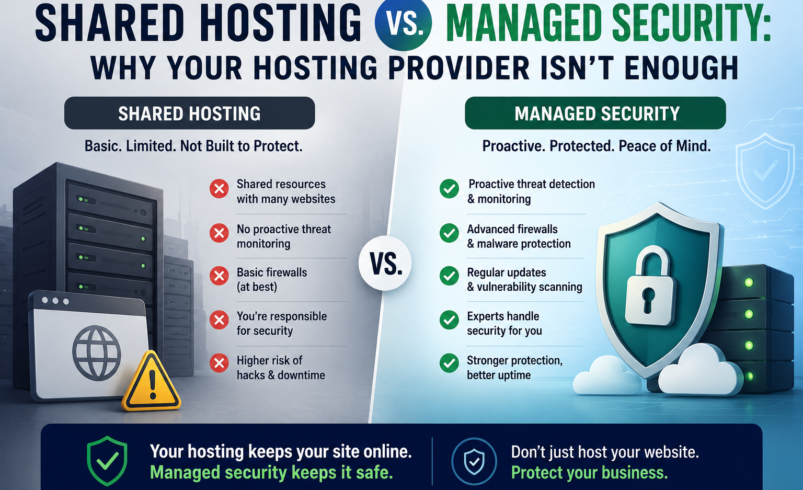

When you set up your website, your hosting provider probably mentioned something about security. Maybe they offered an SSL certificate, or bragged about their server-level firewall. It sounded reassuring. You ticked the box and moved on.
Here’s the uncomfortable truth: your hosting provider’s security is not enough to protect your website. Not even close.
In this post, we’ll break down exactly what shared hosting security covers, what it doesn’t — and why serious website owners need a dedicated security layer to stay protected.
What Does Your Hosting Provider Actually Protect?
It’s important to understand what hosting companies are actually responsible for. Most providers focus on infrastructure-level security:
- Physical server security: Protecting the data centers and hardware.
- Network-level DDoS mitigation: Basic protection against volumetric attacks hitting their network.
- Server OS patching: Keeping the underlying operating system up to date.
- Shared firewall rules: Generic rules that apply to all customers on the server.
Notice what’s missing from that list? Anything to do with YOUR website’s code, files, database, or application layer.
What Shared Hosting Does NOT Protect
This is where most website owners get a nasty surprise. Your hosting provider is generally not responsible for:
- Malware injected into your website files or database
- Vulnerabilities in your CMS, themes, or plugins (WordPress, Joomla, etc.)
- Brute force attacks targeting your login page
- SQL injection or cross-site scripting (XSS) attacks on your web application
- Phishing pages or spam content inserted by hackers
- Your website being blacklisted by Google or other security databases
- Cleaning up after a hack — most hosts will simply suspend your account
Read your hosting provider’s Terms of Service carefully. Most include language that explicitly limits their liability for website-level security incidents. You — the website owner — are responsible for your application’s security.
The Shared Hosting Problem: You’re Not Alone on That Server
On shared hosting, your website lives on the same physical server as potentially hundreds of other websites. If any of those sites gets hacked — and one almost certainly will — your site can be affected too.
This is called cross-site contamination, and it’s a common vector for malware to spread across shared environments. A hacker who compromises one site on a server often gains access to the filesystem of neighboring sites. Your hosting company may catch it eventually — but not before damage is done.
But I Pay for ‘Managed’ Hosting — Doesn’t That Cover It?
Managed hosting is better — but the word ‘managed’ refers to the management of your hosting environment, not your website’s security. Even managed WordPress hosts like WP Engine or Kinsta, which do an excellent job of server hardening and software updates, will tell you directly that they don’t replace a dedicated website security solution.
They handle the infrastructure. You still need to handle the application.
What Dedicated Website Security Actually Provides
A dedicated website security service like Sucuri operates at the application layer — the layer your hosting provider doesn’t touch. Here’s what that means in practice:
- Web Application Firewall (WAF): Filters malicious traffic before it ever reaches your server, blocking SQL injection, XSS, brute force, and more.
- Malware scanning & monitoring: Continuously scans your website files and database for malicious code, backdoors, and suspicious changes.
- Blacklist monitoring: Alerts you immediately if your domain is flagged by Google, McAfee, Norton, or other security authorities.
- DDoS protection: Application-layer DDoS mitigation that protects your site specifically — not just your host’s network.
- Malware removal: When something goes wrong, a team of security experts cleans your site — guaranteed, with unlimited cleanups.
- Performance CDN: Sucuri’s global CDN also speeds up your website while keeping it secure.
A Real-World Analogy
Think of it this way: your hosting provider is like the property management company for the building where your office is located. They maintain the building, handle utilities, and have a lock on the front door.
But they don’t guard your office specifically. They’re not watching your filing cabinets or checking who’s accessing your computers. That’s your responsibility.
Dedicated website security is the equivalent of having your own security system, alarm, and guard for your specific office — not just the building.
How Much Does This Gap Cost Businesses?
The numbers are sobering. According to industry research, the average cost of a website hack for a small business includes:
- Lost revenue during downtime (often days or weeks)
- Emergency malware removal costs (hundreds to thousands of dollars)
- SEO recovery — rankings can take months to restore after a blacklisting
- Reputational damage and lost customer trust
- Potential regulatory fines if customer data was exposed (GDPR, PCI-DSS)
Meanwhile, a comprehensive website security plan from Sucuri costs a fraction of those figures — and includes everything from prevention to cleanup.
What Should You Do Right Now?
If you’re relying solely on your hosting provider for security, here’s a practical action plan:
- Check whether your hosting plan includes any application-level security (most don’t)
- Run a free scan of your website to check for existing malware or blacklisting
- Set up a web application firewall to stop attacks at the edge
- Enable continuous monitoring so you’re alerted instantly to threats
- Have a malware removal plan ready — know who you’ll call if something goes wrong
🛡️ Sucuri gives you all of this in one platform. Start your free website scan here and find out in minutes whether your site is already at risk — then get the protection your hosting provider was never designed to provide.
The Bottom Line
Your hosting provider does an important job — but it’s not the job of protecting your website from hackers. That responsibility falls to you, and the tools to handle it are more affordable and accessible than most people realize.
Don’t wait until a hack, a blacklisting, or an account suspension forces the issue. Build your security layer now, while everything is still running smoothly.